


Dohány Street Synagogue – often simply called the Great Synagogue – is one of the most remarkable buildings in Budapest, both for its breathtaking architecture and for the deeply emotional history connected to it.
Located on Dohány Street in Budapest’s lively 7th district, right in the heart of the historic Jewish Quarter, the synagogue stands surrounded by ruin bars, trendy cafés, elegant restaurants and crumbling old apartment buildings that together create one of the city’s most unique atmospheres.
And honestly, that contrast somehow feels very Budapest.
Before World War II, Budapest had one of the largest Jewish communities in Europe. More than 20% of the city’s population was Jewish at the time, making Budapest an important center of Jewish culture, religion and intellectual life.
Today, the Great Synagogue remains both a major religious site and one of the city’s most visited landmarks.

Europe’s largest synagogue
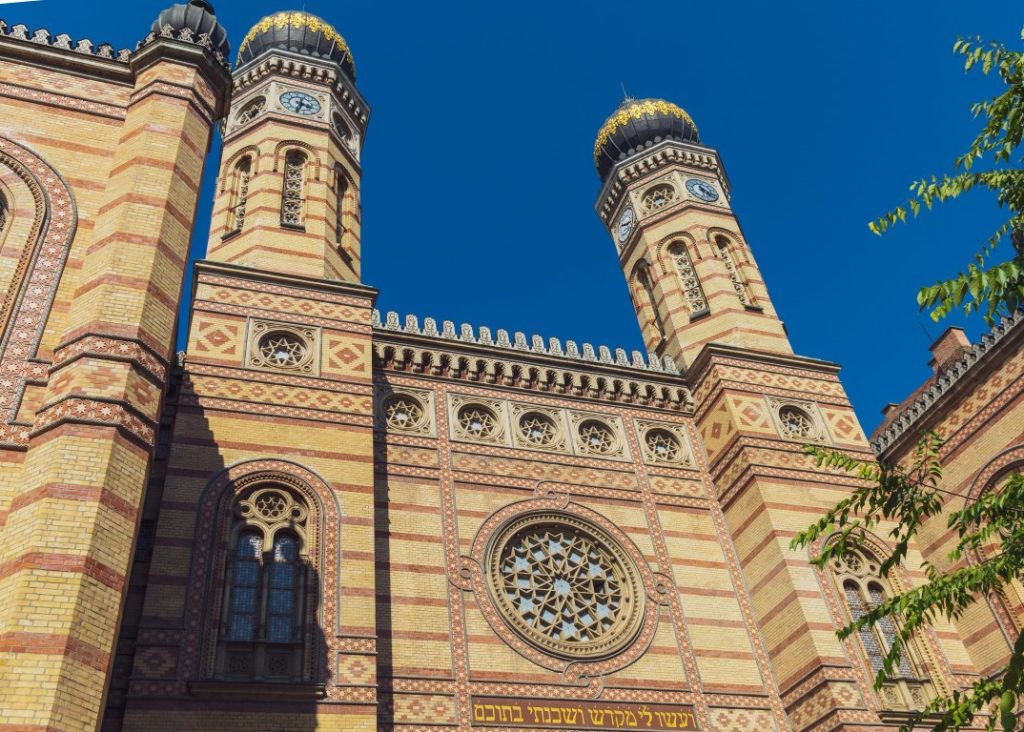
The synagogue was built between 1854 and 1859 in striking Moorish Revival style by Viennese architect Ludwig Förster, with additional Byzantine and Gothic influences woven into the design.
With nearly 3,000 seats, it is the largest synagogue in Europe and one of the largest in the world.
Even if you are not particularly interested in religious architecture, the building is impossible not to admire. The colorful brickwork, arched windows and enormous onion-domed towers look almost more like something from Andalusia or the Middle East than Central Europe.
The two octagonal towers rise 43 meters high and are topped with distinctive onion domes decorated with gold details that dominate the surrounding streetscape.
Inside the synagogue
The interior is just as impressive as the exterior.
Designed by Hungarian architect Frigyes Feszl, the synagogue is richly decorated with geometric patterns, painted details and golden ornaments. The enormous space feels both grand and surprisingly warm at the same time.
One unusual feature is the organ, something rarely found in synagogues.
The magnificent instrument contains around 5,000 pipes, and according to historical records even legendary composers like Franz Liszt and Camille Saint-Saëns performed here.
The synagogue’s ark also preserves several Torah scrolls rescued from synagogues destroyed during the Holocaust.

A place shaped by history
Like much of Budapest, the synagogue suffered severe damage during World War II, particularly during the Siege of Budapest.
During the Communist era only minimal restoration work was carried out, and the once magnificent building slowly deteriorated for decades.
Its full restoration finally took place between 1991 and 1996, supported in part by famous Hungarian-Jewish figures including Tony Curtis and Estée Lauder.
Today the building has been beautifully restored and once again stands as one of Budapest’s architectural treasures.

More than just a synagogue
The Great Synagogue complex includes several important memorial and cultural sites that are absolutely worth exploring during your visit.
Jewish Museum
The Jewish Museum houses religious objects, historical documents and exhibitions presenting the history of Hungarian Jewish life and culture.
Heroes’ Temple
Built after World War I, the Heroes’ Temple commemorates Hungarian Jewish soldiers who lost their lives during the war.
Raoul Wallenberg Memorial Park
Behind the synagogue you’ll find the moving Raoul Wallenberg Memorial Park, home to the famous Holocaust Memorial Tree, also known as the Tree of Life.
Its metal leaves are engraved with the names of Hungarian Jewish victims murdered during the Holocaust.
It is one of the most emotional memorials in Budapest.
Jewish Cemetery
Unusually, the complex also contains a cemetery within the synagogue grounds. During the horrific final months of World War II, thousands of victims from the Budapest Ghetto were buried here.

Visiting the Jewish Quarter
Exploring the synagogue also gives you the perfect excuse to discover Budapest’s Jewish Quarter itself, one of the city’s most vibrant neighborhoods today.
The surrounding streets are packed with:
- ruin bars
- cafés
- bakeries
- street art
- kosher restaurants
- nightlife spots
- historic buildings.
It’s one of those parts of Budapest where history and modern city life exist side by side almost everywhere you look.
And while the district is now famous for nightlife and tourism, places like the Great Synagogue serve as powerful reminders of the community and history that shaped this neighborhood long before the ruin bars arrived.
Practical information
For current opening hours, ticket prices, dress code and visiting rules, it’s always best to check the official website before your visit, especially around Jewish holidays when opening times may change.
If you would like to explore the Jewish Quarter beyond the synagogue itself, free guided walking tours are also available in Budapest. You can find more information here: Free Jewish Quarter Tours
If you enjoyed this blog post, follow me on Facebook, Instagram, and other social media for more updates and behind-the-scenes content. For even more inspiration, check out my constantly updated Pinterest boards, where I share ideas, recipes, travel tips, and more!
This article was updated in January 2026 with the latest tips and information.