


I’ve always loved food markets. Not just because of the food itself, although honestly that part helps a lot. I love the atmosphere around them too: the smell of fresh vegetables and fruits, the noisy butchers, the mountains of spices, the endless chatter between vendors and customers. Somehow markets always feel more alive than supermarkets ever could.
They also remind me of my childhood.
Every summer I spent my holidays at my grandmother’s house, and we used to visit the local market almost every single morning. Buying ingredients for lunch was never a quick errand. We spent hours walking between stalls, chatting with farmers, inspecting tomatoes like serious food critics and debating which watermelon looked the most promising.
These days real life is obviously less romantic. Most weekdays I grab groceries quickly from supermarkets like everybody else. But ever since Chef Nacho came into my life, Saturday mornings often mean one thing: heading to Budapest’s famous Central Market Hall together for our weekly food shopping ritual.
And I still love it every single time.
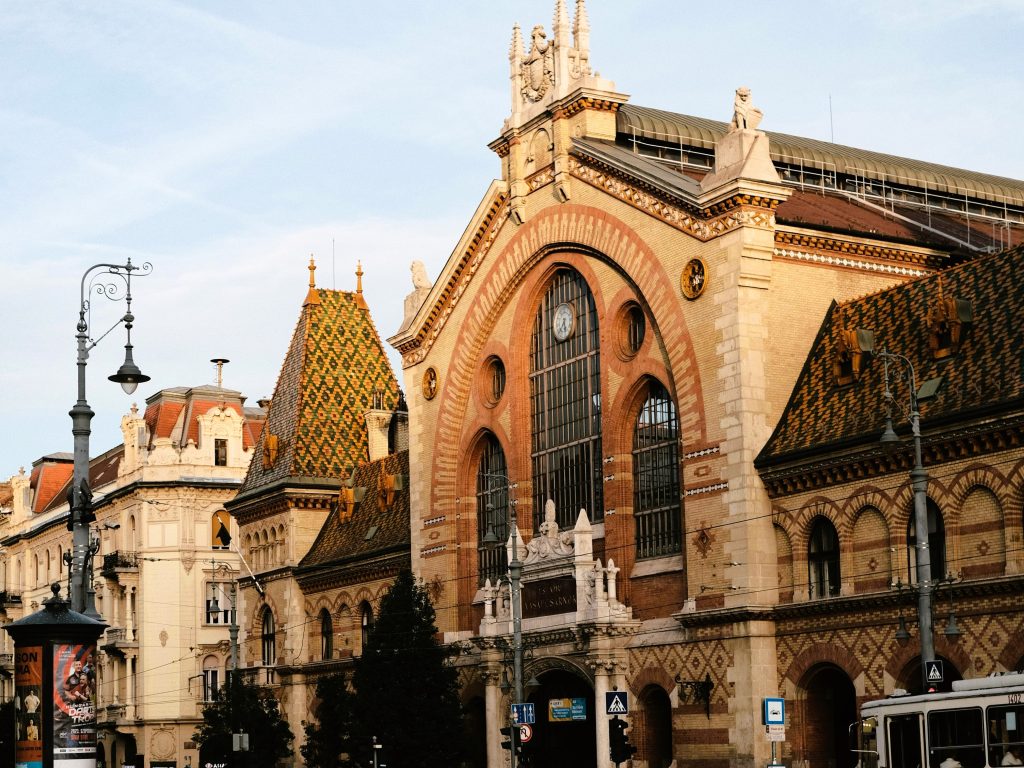
Budapest’s most famous market hall
Central Market Hall – or Nagyvásárcsarnok in Hungarian – stands right at the Pest side of Liberty Bridge and is easily one of Budapest’s most iconic food destinations.
Built in 1897 and designed by Hungarian architect Samu Pecz, it became the city’s main indoor market hall during Budapest’s great architectural boom at the end of the 19th century.
Although several beautiful market halls were built around the same time – including the ones at Hold Street, Klauzál Square, Hunyadi Square and Rákóczi Square – the Central Market Hall eventually became the superstar of them all.
And honestly, once you see it, it’s not hard to understand why.
The building itself is gorgeous. The Neo-Gothic entrance gate already feels impressive, but the real eye-catcher is the colorful Zsolnay tiled roof, the same famous ceramic tiles you can also spot on Matthias Church.
During World War II the market hall suffered serious damage, but after a major restoration in the 1990s, it regained its former glory and today it looks better than ever.
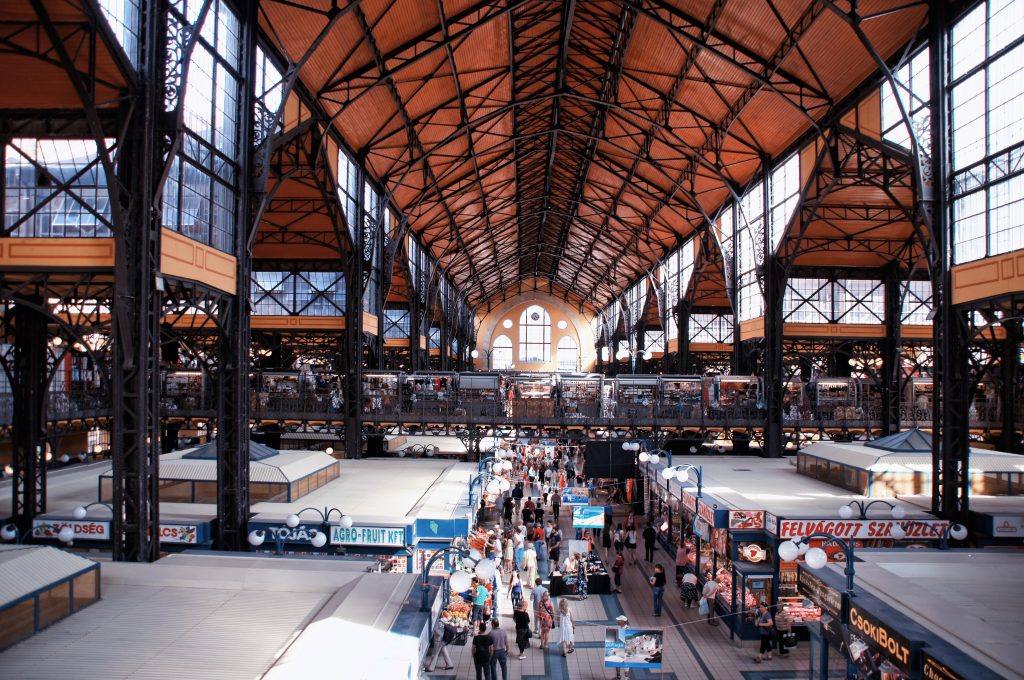
Three floors of Hungarian food heaven
The Central Market Hall has three levels, and honestly, arriving hungry is both highly recommended and slightly dangerous.
The main floor is the heart of the market:
- fresh fruits and vegetables
- meats and sausages
- local cheeses
- bakeries and pastries
- spices
- pickles
- Hungarian wines and pálinka.

Fresh veggies and paprika at Central Market Hall in 2016
And of course, mountains of bright red Hungarian paprika everywhere.

Central Market Hall ground floor Hungarian paprika in 2016
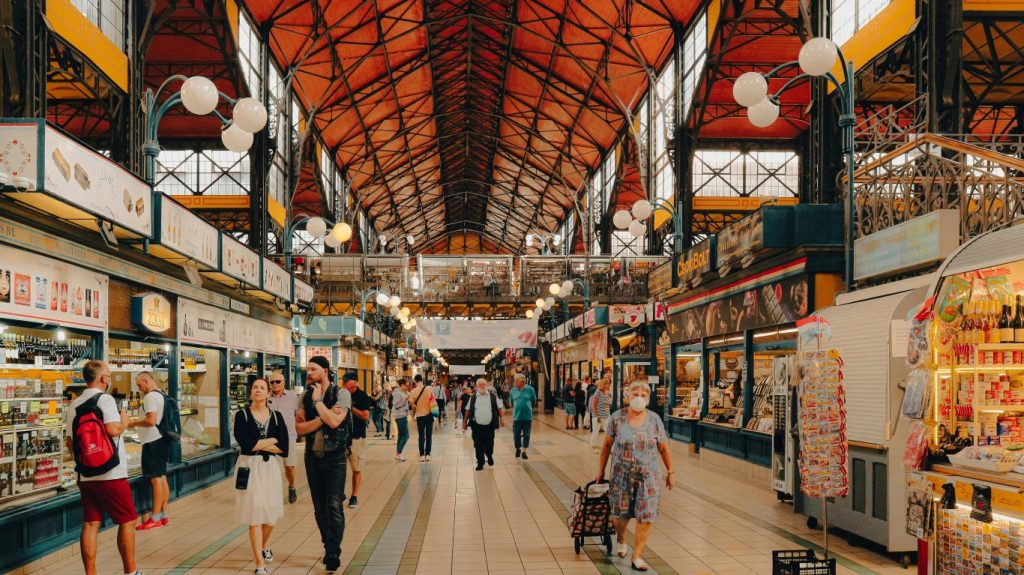
Even if you don’t plan to buy anything, walking through the market is already an experience on its own. Vendors shout prices, tourists photograph giant salamis, locals argue over which peppers are best for stuffed paprika, and somewhere nearby somebody is probably slicing fresh pogácsa.
Basically: welcome to Hungary.
The upstairs food court
If the ground floor makes you hungry, the upstairs food court finishes the job properly.
Around lunchtime the second floor becomes wonderfully chaotic as both locals and tourists hunt for quick Hungarian comfort food between sightseeing stops.
This is one of the best places in Budapest to try classic Hungarian market dishes without spending a fortune.

And yes, you absolutely should try a fresh lángos here. Golden, crispy, greasy in the best possible way and usually covered with sour cream and cheese, lángos is basically Hungary’s answer to “What if pizza and deep-fried bread had a very irresponsible but delicious child?”
Even better with a cold beer.
Besides the food stalls, the upper floor also has plenty of traditional Hungarian handicrafts, embroidery, ceramics, folk art products and tourist souvenirs. Some are genuinely beautiful, some are… well… aggressively touristy. Let’s just say not every paprika-shaped fridge magnet needs to come home with you.

Don’t skip the basement
Most tourists never make it downstairs, which is honestly a mistake.
The basement feels much less touristy and much more local. Here you’ll find:
- fish stalls
- butcher shops
- supermarkets
- and one of Hungary’s greatest obsessions: pickles.
Not just cucumber pickles either. Hungarians pickle absolutely everything:
- cabbage
- cauliflower
- garlic
- peppers
- tomatoes
- beets.
If it can physically fit inside vinegar, there is a strong chance Hungarians have already tried pickling it.

Practical information
Central Market Hall is currently open Monday to Saturday, and in recent years some parts of the market have also started operating on Sundays with limited vendors and shorter opening hours.
Current opening hours are generally:
- Monday: 6 am – 5 pm
- Tuesday to Friday: 6 am – 6 pm
- Saturday: 6 am – 3/4 pm
- Sunday: limited opening hours with selected stalls only.
Saturday mornings are usually the busiest, when locals and tourists completely flood the building before the weekend. If you prefer a calmer experience, weekday mornings are much more enjoyable.
The upstairs food court gets especially chaotic around lunchtime, somewhere between delicious and mildly overwhelming. But that’s part of the charm.
If you enjoyed this blog post, follow me on Facebook, Instagram, and other social media for more updates and behind-the-scenes content. For even more inspiration, check out my constantly updated Pinterest boards, where I share ideas, recipes, travel tips, and more!
This article was updated in February 2026 with the latest tips and information.