


Eight famous bridges span the Danube in Budapest, connecting Buda and Pest – and each of them has its own character, style, and story. But if there’s one that truly defines the city, it’s the Széchenyi Chain Bridge. Not only is it one of the most iconic landmarks in Budapest, but it’s also the place where your journey to the Buda side often begins.
The first permanent bridge of Budapest
The Széchenyi Chain Bridge (Széchenyi Lánchíd) was the very first permanent bridge connecting Buda and Pest, built between 1838 and 1849.
It was designed by the Scottish engineer Adam Clark and constructed by William Tierney Clark. The project was initiated and financed by István Széchenyi, whose vision went far beyond just building a bridge. He wanted to bring the two sides of the city, and in a way the whole country, closer together.
At the time, Buda and Pest were still separate cities, and the Chain Bridge became their very first permanent connection.

The bridge was heavily damaged during World War II, like many others in the city, but it was rebuilt and reopened in 1949.
More recently, it went through a major transformation again. After a 25-month renovation, the Chain Bridge reopened in August 2023, and it feels noticeably different today.
Private cars are no longer allowed to cross, which makes the whole experience much calmer and more enjoyable. The bridge is now open to pedestrians, cyclists, taxis, and public transport, with improved sidewalks and enhanced lighting.
And honestly, this change makes a big difference. Walking across the bridge today feels less rushed and more like an experience in itself with uninterrupted views of the Danube, the Parliament, and Buda Castle.
Lions, legends and lights
The massive stone lions guarding the entrances were added in 1852 and quickly became part of the bridge’s identity.
There’s a well-known urban legend that these lions have no tongues – something you’ll probably hear at least once during your stay in Budapest. Rumor has it that the iconic stone guardians on either side of the bridge were carved without tongues.
In reality, they do have tongues, you just can’t see them from the ground.
Today, the Chain Bridge remains the oldest bridge in Budapest and without a doubt, one of the most beautiful, especially at night when it’s lit up like a chandelier.

Castle Hill Tunnel – the hidden continuation
Right at the Buda end of the bridge, you’ll find the Castle Hill Tunnel (Budai Váralagút), also designed by Adam Clark and built between 1853 and 1857. Its neoclassical entrance mirrors the architectural style of the Chain Bridge, creating a seamless visual connection between the two.
What many people don’t realize is that the tunnel actually has apartments built into it. For decades, the caretaker of the Chain Bridge lived here, although these spaces have been empty since 2007 and are still awaiting full renovation.
Above the tunnel, there’s a terrace offering a surprisingly great view – and in the summer, it sometimes turns into a lively spot where people gather, even for spontaneous salsa dancing events.
And then there’s the classic Budapest joke: since the tunnel is almost exactly the same length as the bridge, it was supposedly built so the Chain Bridge could be moved inside when it rains.
Castle Hill Funicular – the easy way up
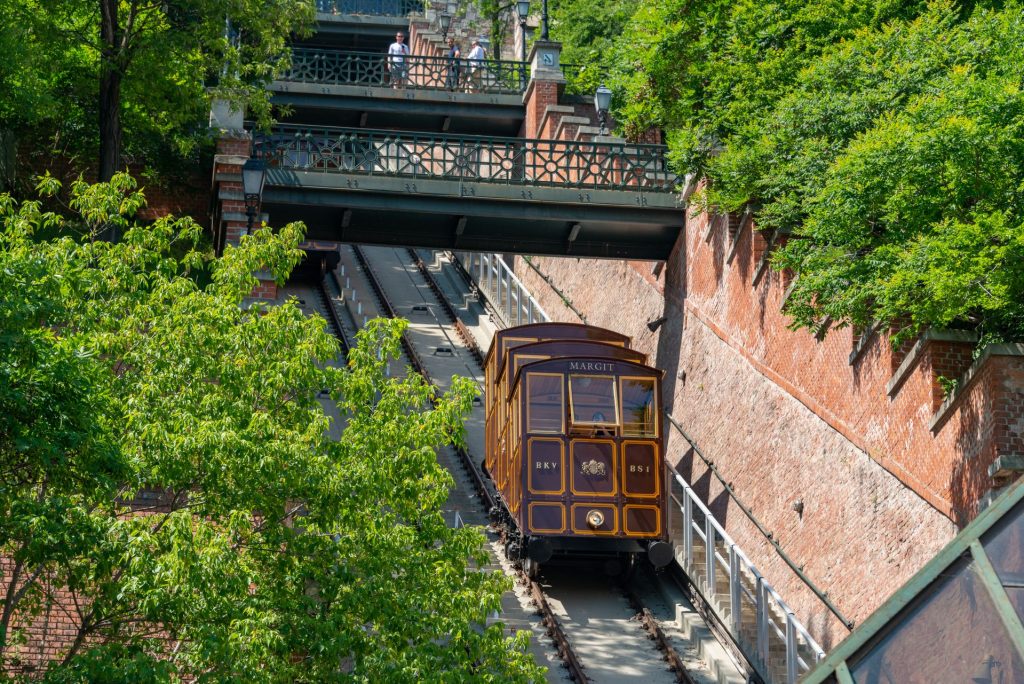
If you’d rather skip the uphill walk, the Castle Hill Funicular (Budavári Sikló) is right there.
Opened in 1870, it was the second funicular of its kind in Europe at the time. Although it was destroyed during World War II, it was later rebuilt to its original design and reopened in 1986.
Today, the two small cars still carry passengers up and down between the Chain Bridge and Buda Castle – and it’s easily one of the most scenic (and fun) short rides in the city.
Zero Kilometer Stone
Just next to the bridge, you’ll notice a somewhat unusual sculpture: the Zero Kilometer Stone. Created by Miklós Borsos, this 3-meter-high limestone “zero” marks the point from which all road distances in Hungary are measured.
In a way, it symbolizes the centre of the country – even though its original location was once closer to Buda Castle before being moved here.
Why this area is worth your time
This small area around the Chain Bridge is one of those places in Budapest where everything comes together. History, architecture, views and the feeling that you’re standing right at the meeting point of Buda and Pest.
Whether you’re crossing the bridge, heading up to the castle, or just taking in the view of the Danube, it’s one of those spots you’ll probably return to more than once during your stay.
Stay connected
If you enjoyed this blog post, follow me on Facebook, Instagram, and other social media for more updates and behind-the-scenes content. For even more inspiration, check out my constantly updated Pinterest boards, where I share ideas, recipes, travel tips, and more!
This article was updated in January 2026 with the latest tips and information.